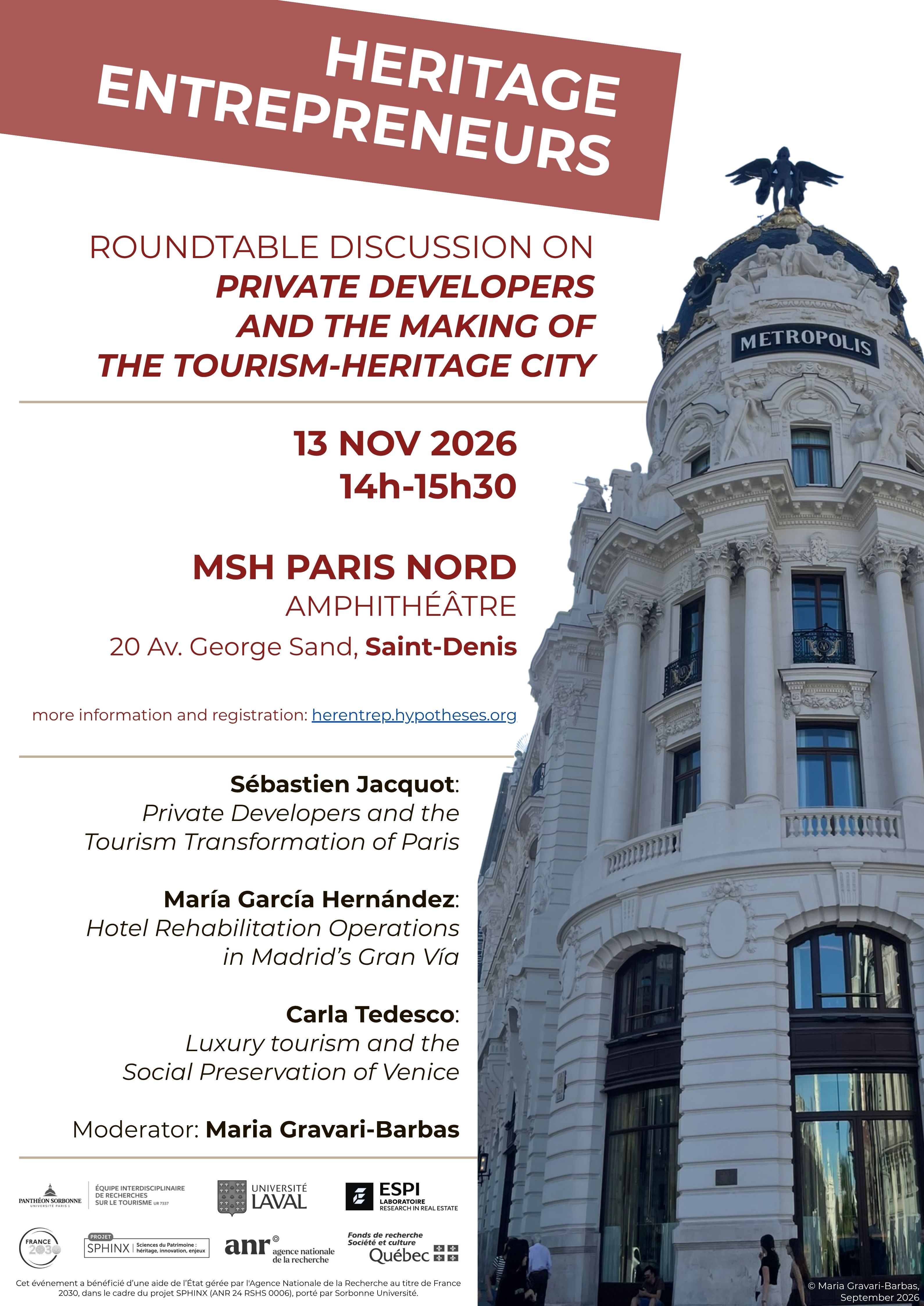
Private Developers and the Making of the Tourism-Heritage City
Round Table organized in the framework of the closing conference of HerEntrep project.
13 November 2026
14h-15h30 MSH PARIS NORD 20 Av. George Sand, Saint-Denis
For more information and registration: herentrep.hypotheses.org
Roundtable Contributions:
Moderator: Maria Gravari-Barbas, professor, EIREST, Paris 1 Panthéon-Sorbonne University
- Tourism as a Driver of Heritage Redevelopment: Private Developers and the Tourism Transformation of Paris
Sébastien Jacquot, associate professor, IREST, Paris 1 Panthéon-Sorbonne University - The tourist reconfiguration of urban heritage: hotel rehabilitation operations in Madrid’s Gran Vía
María García Hernández, professor, Complutense University of Madrid - Beyond Bricks and Stones: Luxury tourism and the Social Preservation of Venice
Carla Tedesco, associate professor, Iuav University of Venice
Round Table presentation:
Private real-estate developers have become central actors in the production of the contemporary tourism-heritage city. In many historic centres and UNESCO World Heritage properties, they are increasingly shaping the future functions, economic models and social trajectories of heritage districts. While residential redevelopment remains the primary destination of most rehabilitation projects, tourism has arguably become an equally significant function assigned to historic buildings. Hotels, serviced apartments, heritage accommodation, cultural venues, gastronomic spaces and leisure facilities have become recurrent outcomes of adaptive reuse, profoundly transforming the functional geography of historic urban centres.
This evolution raises questions that extend far beyond architectural conservation. It invites us to examine the growing role of private developers in defining what historic cities become, which heritage assets are considered economically viable, and which tourism functions are deemed appropriate within protected urban environments. How developers respond to market demand? Beyond this, how are they actively producing new tourism imaginaries and new forms of urban centrality? To what extent do heritage regulations, UNESCO designation, fiscal incentives and planning instruments shape these projects? Conversely, how do developers adapt, negotiate or sometimes circumvent these regulatory frameworks?
Historic centres and UNESCO perimeters constitute particularly revealing observatories of these dynamics. These highly protected urban environments concentrate exceptional heritage values while simultaneously attracting tourism investment, real-estate capital and public attention. They therefore offer a privileged setting for examining the tensions between conservation and economic development, public regulation and private initiative, residential functions and tourism uses.
The roundtable also seeks to explore the political dimension of these projects. Local authorities often face contradictory objectives: preserving heritage, maintaining residential life, supporting local commerce and ensuring economic vitality, while simultaneously encouraging investment and tourism development. Under what conditions do municipalities accept, negotiate or promote tourism-oriented redevelopment projects? When do they attempt to limit them? How are these projects perceived by local residents and heritage associations? Which planning tools, fiscal mechanisms and heritage regulations facilitate tourism conversion, and which instruments allow cities or communities to resist it?
More fundamentally, this discussion invites us to question whether we are witnessing the emergence of a new model of heritage urbanism in which private developers have become indispensable partners in conservation, but also major producers of the tourism-historic city itself.
Questions for discussion :
- Who are today's private developers operating in historic centres and UNESCO World Heritage properties? Has a specific profile of "heritage developer" emerged?
- Why has tourism become one of the dominant functions in the adaptive reuse of historic buildings?
- How are tourism-oriented heritage projects financed and assembled? Which business models underpin these developments?
- How do UNESCO designation, heritage regulations, planning instruments and fiscal incentives shape developers' strategies?
- How do local authorities negotiate the tension between heritage conservation, residential functions and tourism development?
- Under what conditions are tourism functions accepted, promoted or resisted in historic centres?
- How are these projects perceived by residents, heritage organisations and local communities?
- Are private developers simply responding to existing tourism demand, or are they actively producing new tourism-heritage landscapes and reshaping the identity of historic cities?
- What are the long-term implications of these projects for the social, functional and economic future of historic centres and UNESCO properties?